
The Psychology of Pain: Why Your Brain Guarding Keeps You Hurt
By Ashley Hernandez
The Psychology of Pain: Why Your Brain Guarding Keeps You Hurt
By Ashley Hernandez
Pain is not strictly a local physical event. Real-time pain is generated entirely by your central nervous system (CNS).
Pain is an output, a signal from your brain. Its primary goal is simple: protection. Your brain continuously analyzes internal and external inputs to recognize threats - both real and perceived - in order to keep you safe.
Your past injuries, emotional state, and beliefs about your body and what it is capable of heavily dictate how your brain calculates a “perceived threat.” While this alarm system is a vital survival mechanism during an acute injury, it can overstay its welcome long after structural tissue has healed.
Healing Does Not Equal Pain Freedom
Consider this scenario: you injured your knee years ago playing soccer and squatting immediately became painful. Today, years later, you still experience knee pain when you squat.
The structural trauma from that initial injury healed long ago. Even if you sustained a partial tear that was never surgically repaired, the local tissue (surrounding musculature) has stabilized. A tear or other structural abnormality does not guarantee pain. Millions of people walk around with torn ligaments, disc herniations, and joint degeneration that they never even feel or know about.
If your tissue has healed, why do you still hurt? Because your brain has stored the memory of: Squatting equals danger. Your nervous system’s job is to keep you safe, even when its protective protocols are outdated. So if your brain thinks squatting = danger, it’s going to find a way to protect you.
Understanding "Guarding": The Nervous System’s Lock-Down
Guarding is a neurological response to a perceived threat. It’s the involuntary stiffening you experience when an aggressive dog charges you from across the street, or when you slam on the brakes to avoid a highway collision.
It is also exactly what you body does when it suspects a joint or muscle group cannot handle load.
If your brain lacks confidence in your ability to deadlift due to historical weakness or past trauma in your core, hips, or lower back, it will actively guard against that movement. Neurological guarding can manifest as:
Chronic muscle tightness or restricted range of motion
Sharp, protective muscle spasms
Complete inability to recruit target muscle groups
Think of this as the classic “fight, flight, or freeze” response. Guarding is your nervous system choosing to freeze an area to prevent perceived damage.
Using the Breath to Disarm the Alarm System
To eliminate protective guarding, you must prove to your nervous system that it is safe. Your primary tool for resetting this threat threshold is your breath control.
When your body enters a high-threat state, your breathing naturally becomes shallow, rapid, and chest-dominant. This chest breathing pattern reinforces the idea that you are in danger, signaling back to the brain that you are under stress, which amplifies pain.
By taking control of your respiratory pattern, you can down-regulate your nervous system, suppress the threat response, and rewrite the movement pattern as safe.
The Targeted Exhale Strategy
Beyond general diaphragmatic breathing, there is a strategic way to utilize breathwork during movement: Exhale directly through the most painful or restrictive phase of the exercise.
If bending over during a deadlift triggers lower back pain, exhale with control the moment you begin to hinge.
This targeted down-regulation inhibits protective tone. In real time, clients notice an immediate increase in usable range of motion and/or a significant drop in pain intensity. Once you unlock that window of safe movement, you have a baseline to build on.
Emotion, the Unknown, and Controlled Exposure
Pain intensity is heavily multiplied by 2 factors: emotions and uncertainty. High stress and emotional distress ramp up nervous system sensitivity. Likewise, if you don’t understand why your body hurts, your brain views the pain as a threat to your survival.
Consider a child stubbing their toe or getting an ant bite for the first time. Their reaction is extreme - screaming, crying, panicking. They lack context and exposure to this perceived threat, so their brain responds as if they’ve lost a limb. An adult experiencing the same ant bite barely flinches. You have been exposed to that threat before, survived, and know you will be fine. Your brain has context.
To disarm chronic pain patterns, your nervous system requires that exact same exposure - over and over again, in a controlled environment, under expert guidance, using regulated breathing.
The Progression Framework: From Low Threat to High Capacity
When we suggest a previously painful movement to a new client, their immediate reaction is often a defensive “Hell no.” You can see their body stiffen, alarm bells ringing, and stress spiking before they even tough a weight. We understand. They haven’t worked with us long enough yet to know they can trust us with their pain - they haven’t had enough exposure.
We never force a client directly into a high-threat movement. Instead, we scale the pattern back to a low-threat entry point:
1. Pattern Regression: If a traditional barbell deadlift is perceived as an extreme threat, we regress to a floor-based glute bridge or a hip thruster. We find the exact threshold where the movement pattern is slightly challenging, but low-threat enough for the client to keep their emotions and breathing under control.
2. Gradual Desensitization: Once the brain stops guarding against the entry-level exercise, we progressively introduce load and dynamic movement.
3. Re-Integrating the Primary Pattern: Step by step, we work up to the original “scary” movement. Because we desensitized the kinetic chain along the way, the big movement no longer triggers the brain’s alarm bells.
The Path to Permanent Resilience
Disarming a painful movement once is a major breakthrough, but it is only the first step. Achieving permanent freedom from chronic pain requires volume, variation, and repetition.
Once a movement like the deadlift is no longer perceived as a threat, you must expose your body to that pattern in many different ways:
Traditional Kettlebell and Dumbbell Deadlifts
Unilateral / Single-Leg Variations (B-Stance, RDLs)
Multi-Planar & Rotational Load Patterns
Single exposures do not create lifelong adaptations. Continuous, progressive exposure is what your nervous system needs in order to rewire those connections, build structural capacity, and ensure you never have to live in fear of your own movement again.
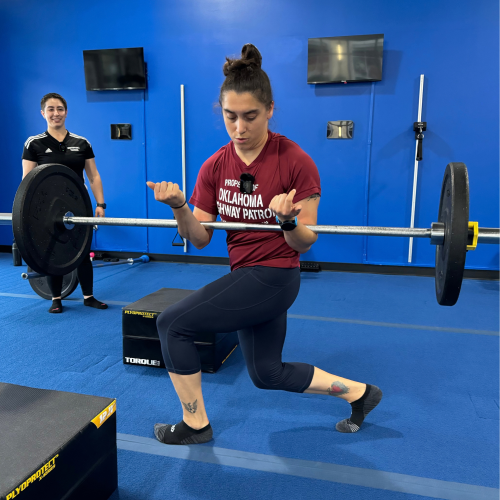
Pain is not strictly a local physical event. Real-time pain is generated entirely by your central nervous system (CNS).
Pain is an output, a signal from your brain. Its primary goal is simple: protection. Your brain continuously analyzes internal and external inputs to recognize threats - both real and perceived - in order to keep you safe.
Your past injuries, emotional state, and beliefs about your body and what it is capable of heavily dictate how your brain calculates a “perceived threat.” While this alarm system is a vital survival mechanism during an acute injury, it can overstay its welcome long after structural tissue has healed.
Healing Does Not Equal Pain Freedom
Consider this scenario: you injured your knee years ago playing soccer and squatting immediately became painful. Today, years later, you still experience knee pain when you squat.
The structural trauma from that initial injury healed long ago. Even if you sustained a partial tear that was never surgically repaired, the local tissue (surrounding musculature) has stabilized. A tear or other structural abnormality does not guarantee pain. Millions of people walk around with torn ligaments, disc herniations, and joint degeneration that they never even feel or know about.
If your tissue has healed, why do you still hurt? Because your brain has stored the memory of: Squatting equals danger. Your nervous system’s job is to keep you safe, even when its protective protocols are outdated. So if your brain thinks squatting = danger, it’s going to find a way to protect you.
Understanding "Guarding": The Nervous System’s Lock-Down
Guarding is a neurological response to a perceived threat. It’s the involuntary stiffening you experience when an aggressive dog charges you from across the street, or when you slam on the brakes to avoid a highway collision.
It is also exactly what you body does when it suspects a joint or muscle group cannot handle load.
If your brain lacks confidence in your ability to deadlift due to historical weakness or past trauma in your core, hips, or lower back, it will actively guard against that movement. Neurological guarding can manifest as:
Chronic muscle tightness or restricted range of motion
Sharp, protective muscle spasms
Complete inability to recruit target muscle groups
Think of this as the classic “fight, flight, or freeze” response. Guarding is your nervous system choosing to freeze an area to prevent perceived damage.
Using the Breath to Disarm the Alarm System
To eliminate protective guarding, you must prove to your nervous system that it is safe. Your primary tool for resetting this threat threshold is your breath control.
When your body enters a high-threat state, your breathing naturally becomes shallow, rapid, and chest-dominant. This chest breathing pattern reinforces the idea that you are in danger, signaling back to the brain that you are under stress, which amplifies pain.
By taking control of your respiratory pattern, you can down-regulate your nervous system, suppress the threat response, and rewrite the movement pattern as safe.

The Targeted Exhale Strategy
Beyond general diaphragmatic breathing, there is a strategic way to utilize breathwork during movement: Exhale directly through the most painful or restrictive phase of the exercise.
If bending over during a deadlift triggers lower back pain, exhale with control the moment you begin to hinge.
This targeted down-regulation inhibits protective tone. In real time, clients notice an immediate increase in usable range of motion and/or a significant drop in pain intensity. Once you unlock that window of safe movement, you have a baseline to build on.
Emotion, the Unknown, and Controlled Exposure
Pain intensity is heavily multiplied by 2 factors: emotions and uncertainty. High stress and emotional distress ramp up nervous system sensitivity. Likewise, if you don’t understand why your body hurts, your brain views the pain as a threat to your survival.
Consider a child stubbing their toe or getting an ant bite for the first time. Their reaction is extreme - screaming, crying, panicking. They lack context and exposure to this perceived threat, so their brain responds as if they’ve lost a limb. An adult experiencing the same ant bite barely flinches. You have been exposed to that threat before, survived, and know you will be fine. Your brain has context.
To disarm chronic pain patterns, your nervous system requires that exact same exposure - over and over again, in a controlled environment, under expert guidance, using regulated breathing.
The Progression Framework: From Low Threat to High Capacity
When we suggest a previously painful movement to a new client, their immediate reaction is often a defensive “Hell no.” You can see their body stiffen, alarm bells ringing, and stress spiking before they even tough a weight. We understand. They haven’t worked with us long enough yet to know they can trust us with their pain - they haven’t had enough exposure.
We never force a client directly into a high-threat movement. Instead, we scale the pattern back to a low-threat entry point:
1. Pattern Regression: If a traditional barbell deadlift is perceived as an extreme threat, we regress to a floor-based glute bridge or a hip thruster. We find the exact threshold where the movement pattern is slightly challenging, but low-threat enough for the client to keep their emotions and breathing under control.
2. Gradual Desensitization: Once the brain stops guarding against the entry-level exercise, we progressively introduce load and dynamic movement.
3. Re-Integrating the Primary Pattern: Step by step, we work up to the original “scary” movement. Because we desensitized the kinetic chain along the way, the big movement no longer triggers the brain’s alarm bells.
The Path to Permanent Resilience
Disarming a painful movement once is a major breakthrough, but it is only the first step. Achieving permanent freedom from chronic pain requires volume, variation, and repetition.
Once a movement like the deadlift is no longer perceived as a threat, you must expose your body to that pattern in many different ways:
Traditional Kettlebell and Dumbbell Deadlifts
Unilateral / Single-Leg Variations (B-Stance, RDLs)
Multi-Planar & Rotational Load Patterns
Single exposures do not create lifelong adaptations. Continuous, progressive exposure is what your nervous system needs in order to rewire those connections, build structural capacity, and ensure you never have to live in fear of your own movement again.



Not Physical Therapy.
Not Fitness.
Axiomatic Protocols for Outliers Refusing Physical Limits.
Work With Us
UNSTOPPABLE Archive
Client Case Studies
About Us
Privacy Policy | Terms & Conditions | Accessibility Statement
Not Physical Therapy.
Not Fitness.
Axiomatic Protocols for Outliers Refusing Physical Limits.