
Case Study: Returning to Endurance Biking After Bilateral Hip Replacement
Case Study: Returning to Endurance Biking After Bilateral Hip Replacement
Client: Kristi
Goal: Eliminate debilitating chronic hip pain, recover from double hip replacement surgery, and return to long-distance road biking and outdoor hiking.
Result: Reduced daily discomfort from a constant 7/10 to a manageable 3/10, completed a 20-mile road ride without acute pain, and restored complete physical independence.
The Challenge: When the Mechanical Stop Is Real
For years, Kristi lived for endurance athletics - marathons, triathlons, and long backcountry hikes. But years of high-volume repetitive training, combined with underlying osteoporosis, left her hips severely compromised.
Everyday tasks became a battle. Putting on socks was a multi-step struggle, standing on pavement for longer than 20 minutes triggered severe pain, and getting on her road bike was discouraging because of the pain.
When she first sought help, traditional group fitness classes and generic physical therapy offered temporary relief, but failed to address her root-cause mechanics. Worse, physical diagnostics revealed something movement alone could not fix: advanced bony growths inside her hip sockets acting as mechanical kickstands, physically blocking her legs from rotating.
The Strategy: Pre-Hab, Surgical Precision, and Core-to-Extremity Rebuilding
While UNSTOPPABLE Training prioritizes non-invasive biomechanical resolution, clinical authority means recognizing when structural surgery is necessary. We aligned with Kristi on a clear two-phase strategy:
Phase 1: Pre-Surgical Preparation
Instead of suffering while waiting for surgery, we implemented a targeted strength and mobility program. By strengthening her deep core and surrounding hip stabilizers, we elevated her physical baseline,ensuring her body was resilient enough to recover rapidly from major surgery.
Phase 2: Post-Surgical Reconstruction
Kristi underwent bilateral total hip replacement (right hip first, followed by the left hip 3 months later). Post-surgery, and post surgical physical therapy, her physical joint space was restored, but her nervous system, core stability, and movement confidence were at rock bottom.
We executed a Core-to-Extremity Reconstruction Protocol:
Re-Activating Deep Core: Developed specialized movements like the Deadbug Dumbbell Fly Pass to force her core to automatically brace under dynamic loads without straining her lumbar spine.
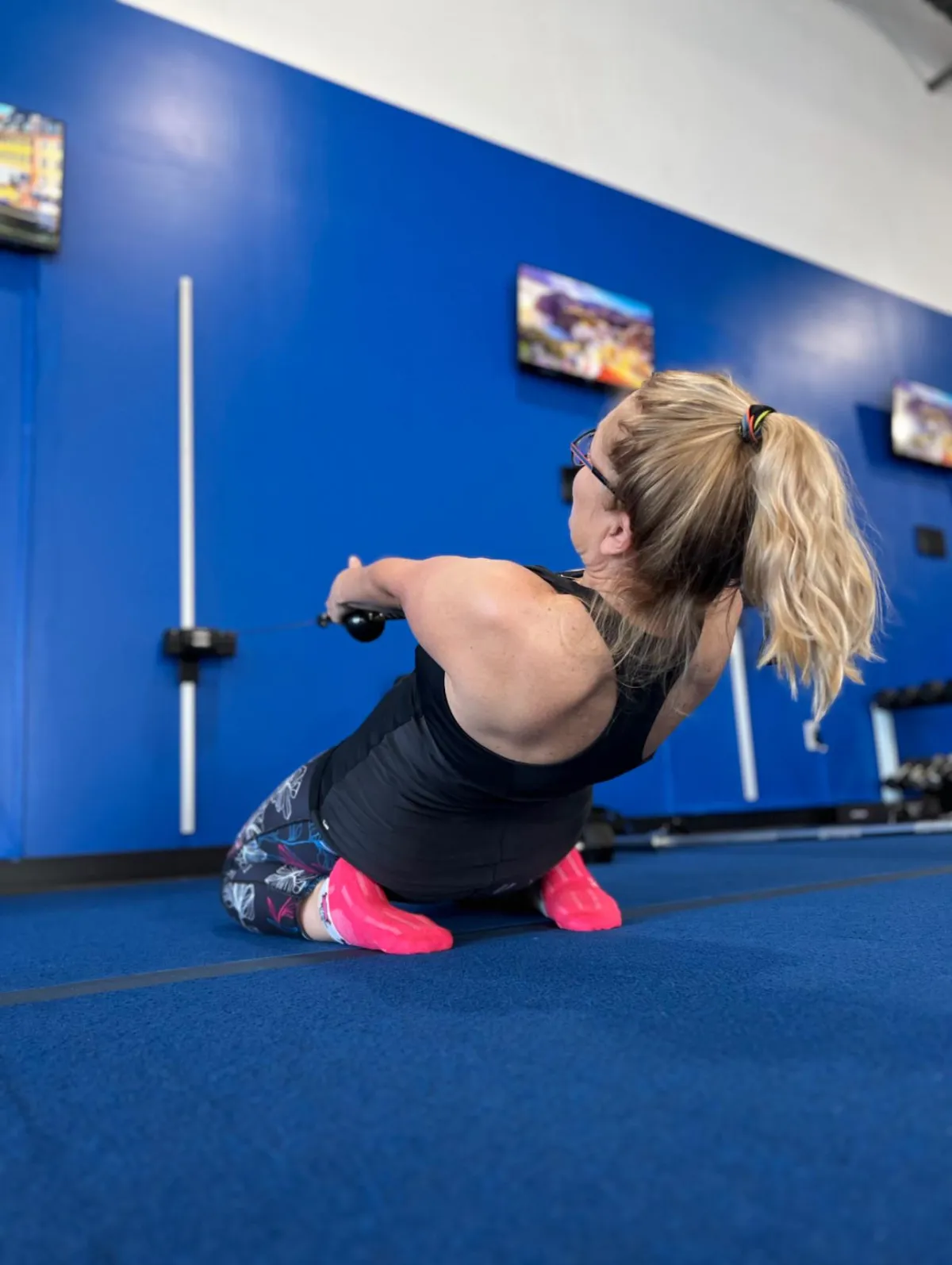
Restoring Symmetrical Strength: Addressed significant left-to-right strength deficits using split squats, single-arm pulling variations, and progressive step-downs.
Rebuilding Unilateral Balance: Implemented monster walks, hip thrusters, and clam shell variations to train her newly acquired hip rotation capacity.
The Results: From Chronic Discomfort to 20-Mile Rides
By combining surgical intervention with personalized biomechanical reconstruction, Kristi achieved structural and functional autonomy:
From 20 Minutes to 2 Hours: Standing on hard pavement shifted from a pain trigger to an afterthought, allowing her to enjoy a 2-hour outdoor concert completely pain-free.
Back on the Saddle: Achieved her ultimate long-term goal by completing a 20-mile outdoor road ride, experiencing only normal, healthy muscular fatigue instead of joint pain.
De-Escalating Pain: Shifted her baseline sensation from a chronic 7 out of 10 Pain down to an occasional 3 out of 10 Irritation, completely eliminating panic around flare-ups.
The UNSTOPPABLE Takeaway
Kristi’s journey proves that true physical reconstruction isn't about avoiding medical interventions when they are necessary. It’s about having the diagnostic clarity to know when structural help is needed, and the systemic framework to rebuild afterwards.
You don't have to "just accept" joint degeneration or abandon the activities that make you feel alive. With an accurate assessment, a custom biomechanical blueprint, and progressive load management, lasting physical autonomy is always within reach.
Client: Kristi
Goal: Eliminate debilitating chronic hip pain, recover from double hip replacement surgery, and return to long-distance road biking and outdoor hiking.
Result: Reduced daily discomfort from a constant 7/10 to a manageable 3/10, completed a 20-mile road ride without acute pain, and restored complete physical independence.
The Challenge: When the Mechanical Stop Is Real
For years, Kristi lived for endurance athletics - marathons, triathlons, and long backcountry hikes. But years of high-volume repetitive training, combined with underlying osteoporosis, left her hips severely compromised.
Everyday tasks became a battle. Putting on socks was a multi-step struggle, standing on pavement for longer than 20 minutes triggered severe pain, and getting on her road bike was discouraging because of the pain.
When she first sought help, traditional group fitness classes and generic physical therapy offered temporary relief, but failed to address her root-cause mechanics. Worse, physical diagnostics revealed something movement alone could not fix: advanced bony growths inside her hip sockets acting as mechanical kickstands, physically blocking her legs from rotating.
The Strategy: Pre-Hab, Surgical Precision, and Core-to-Extremity Rebuilding
While UNSTOPPABLE Training prioritizes non-invasive biomechanical resolution, clinical authority means recognizing when structural surgery is necessary. We aligned with Kristi on a clear two-phase strategy:
Phase 1: Pre-Surgical Preparation
Instead of suffering while waiting for surgery, we implemented a targeted strength and mobility program. By strengthening her deep core and surrounding hip stabilizers, we elevated her physical baseline,ensuring her body was resilient enough to recover rapidly from major surgery.
Phase 2: Post-Surgical Reconstruction
Kristi underwent bilateral total hip replacement (right hip first, followed by the left hip 3 months later). Post-surgery, and post surgical physical therapy, her physical joint space was restored, but her nervous system, core stability, and movement confidence were at rock bottom.
We executed a Core-to-Extremity Reconstruction Protocol:
Re-Activating Deep Core: Developed specialized movements like the Deadbug Dumbbell Fly Pass to force her core to automatically brace under dynamic loads without straining her lumbar spine.
Restoring Symmetrical Strength: Addressed significant left-to-right strength deficits using split squats, single-arm pulling variations, and progressive step-downs.
Rebuilding Unilateral Balance: Implemented monster walks, hip thrusters, and clam shell variations to train her newly acquired hip rotation capacity.
The Results: From Chronic Discomfort to 20-Mile Rides
By combining surgical intervention with personalized biomechanical reconstruction, Kristi achieved structural and functional autonomy:
From 20 Minutes to 2 Hours: Standing on hard pavement shifted from a pain trigger to an afterthought, allowing her to enjoy a 2-hour outdoor concert completely pain-free.
Back on the Saddle: Achieved her ultimate long-term goal by completing a 20-mile outdoor road ride, experiencing only normal, healthy muscular fatigue instead of joint pain.
De-Escalating Pain: Shifted her baseline sensation from a chronic 7 out of 10 Pain down to an occasional 3 out of 10 Irritation, completely eliminating panic around flare-ups.
The UNSTOPPABLE Takeaway
Kristi’s journey proves that true physical reconstruction isn't about avoiding medical interventions when they are necessary. It’s about having the diagnostic clarity to know when structural help is needed, and the systemic framework to rebuild afterwards.
You don't have to "just accept" joint degeneration or abandon the activities that make you feel alive. With an accurate assessment, a custom biomechanical blueprint, and progressive load management, lasting physical autonomy is always within reach.



Not Physical Therapy.
Not Fitness.
Axiomatic Protocols for Outliers Refusing Physical Limits.
Work With Us
UNSTOPPABLE Archive
Client Case Studies
About Us
Privacy Policy | Terms & Conditions | Accessibility Statement
Not Physical Therapy.
Not Fitness.
Axiomatic Protocols for Outliers Refusing Physical Limits.